
Reader comment: “I picked moissanite because it’s a real gemstone”
Whilst it’s true natural Moissanite does exist in nature, none have been found large enough to be used as gemstones. Instead, they are found as microscopic crystals in meteorites. To create a Moissanite large enough to be featured in an engagement ring, science needs to be involved. Whilst many naturally occurring gemstones, such as emeralds, sapphires, and now diamonds, CAN be made in the lab, for Moissanite this is the only way for them to become gemstones.
It’s not the mechanism of their creation that sets the two firm favorite stones for engagement rings apart; it’s the difference in their species (silicon-carbide vs. carbon). There are pros and cons for both, and they have very specific individual appeal, which we explore below.
When Were Lab-Grown Diamonds and Moissanite First Made?
| Milestone | Lab-Grown Diamond | Moissanite |
|---|---|---|
| First successful synthesis | December 16, 1954 – Dr. H. Tracy Hall at General Electric produced the first reproducible HPHT diamond. | 1998 – Charles & Colvard launched the first gem-quality Moissanite after patenting a new SiC growth process. |
| Jewelry-grade boom | Mid-2010s, as Chemical Vapor Deposition (CVD) made large, clean stones affordable | In the late 1990s, it quickly replaced cubic zirconia as the premium “diamond simulant” |
| Popularity in 2024–25 | ≈ 45 % of U.S. engagement rings feature lab diamonds. | Global Moissanite jewelry sales ≈ US $148 million (2024) and growing ~5–10 % CAGR. |
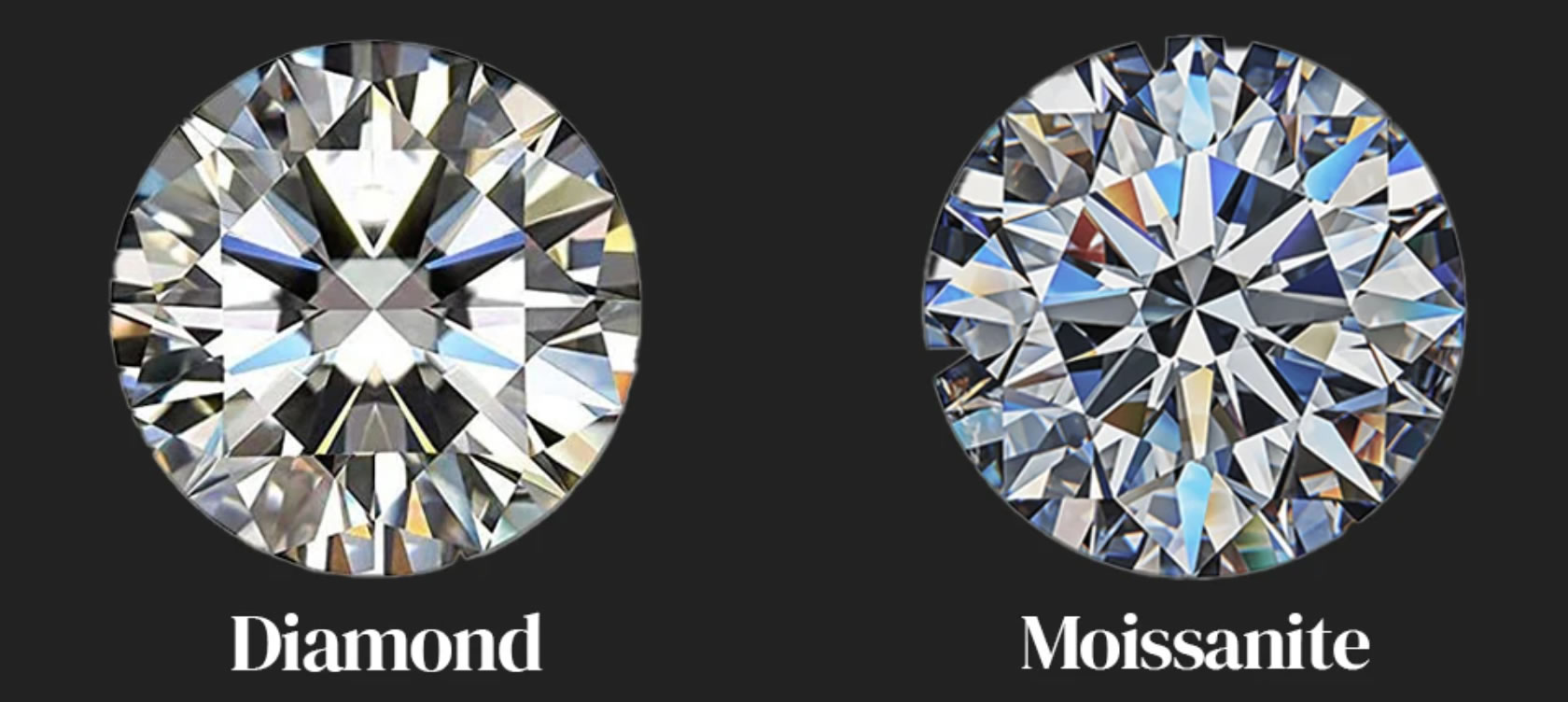
How Do They Look? Brilliance, Fire & Scintillation
| Optical metric | Moissanite | Lab-Grown Diamond |
|---|---|---|
| Refractive index (white sparkle) | 2.65 – 2.69 | 2.42 |
| Dispersion (“rainbow fire”) | 0.104 | 0.044 |
Moissanite’s extra-high dispersion produces bold rainbow flashes, which are great under restaurant lighting but too “disco” for some tastes. Their fans tend to be younger. Lab diamonds mimic mined diamonds’ balanced white scintillation.
Color Grades: Why Moissanite Can Look Warm While Lab Diamonds Stay Icy
Moissanite tops out at D–K on the diamond scale and can show a faint yellow-green tint in some lighting.
Lab diamonds get the same GIA/IGI grades as mined stones and routinely hit D–F after post-growth HPHT treatments.
A lab diamond is the safer bet if you’re ultra-picky about icy whiteness, especially in a platinum setting.
Durability for Everyday Wear
| Metric | Moissanite | Lab-Grown Diamond |
|---|---|---|
| Mohs hardness | 9.25 | 10 |
| Toughness & heat resistance | Very good | Excellent |
Both shrug off household abrasives and jeweler’s torches; diamonds remain the scratch-proof champ.
2025 Pricing: How Much Do They Cost?
Just like with natural gemstones, prices for moisannite and lab-grown diamonds can vary a lot because of different qualities… but pricing tends to be fairly similar, with moissanites being slightly cheaper in larger sizes
| Stone | 1 ct Round, Colorless, VS clarity | 2 ct Round, Near-Colorless |
|---|---|---|
| Lab-Grown Diamond | ≈ US $560 | ≈ US $1 220 |
| Moissanite | ≈ US $600 | ≈ US $1 100 |
Ethics & Sustainability: Carbon Footprint, Mining Impact
Neither gem requires open-pit mining. Grown with renewable electricity, both generate only a few dozen grams of CO₂ per carat, orders of magnitude below mined diamonds.
Certification: GIA Reports vs. Brand Grading
Lab diamonds come with GIA or IGI Laboratory-Grown Reports and laser inscriptions, which are handy for insurance or upgrades.
Moissanite is usually graded in-house (e.g.,Charles & Colvard, Harro Gem). Reputation matters more than paperwork.
Quick Decision Guide
| If you value… | Choose |
|---|---|
| Classic diamond look & stealth wealth | Lab-Grown Diamond |
| Maximum rainbow sparkle per euro | Moissanite |
| Ultimate scratch resistance | Lab-Grown Diamond |
| Lowest upfront cost with minimal carbon footprint | Moissanite |
| Trade-in or upgrade programs | Slight edge to Lab-Grown Diamond |
Final Thoughts
Both stones free you from the ethical baggage and sticker shock of mined diamonds. Decide which sparkle style makes you smile, how perfect you need the color, and whether the word diamond is on a grading report matters once the ring is on your hand.
At Peter Norman we keep the process straightforward. If you’re deciding between moissanite and lab-grown diamonds, we’ll lay out several examples of each—different cuts, sizes, and quality grades—so you can compare them side by side under normal lighting. You leave knowing exactly which type and which specific stone meets your budget and visual preferences.
