

Two carats has quietly become the size most couples ask for first. A decade ago a one carat center was the standard request and two carats felt like a stretch. That has flipped. Most of the rings leaving our Los Angeles workshop now carry a center somewhere between 1.5 and 2.5 carats, and two is the number people say out loud when they describe what they picture.
There is a clear reason for the shift, and a lot of practical detail underneath it. Two carats is large enough to read as a real statement and still proportionate on most hands, which is a balance that does not hold once you push much higher. What follows is how a two carat diamond actually behaves, what it costs in 2026, and how to build a ring that carries the weight gracefully.
How big a 2-carat diamond actually looks
Carat is weight, not diameter. A well cut 2-carat round brilliant measures roughly 8.1 to 8.2mm across. For comparison, a 1-carat round sits near 6.5mm, so two carats is not twice the spread of one carat, it is closer to a quarter wider face up. The extra weight goes into depth as much as width.
 Round Diamond Engagement Ring With Hidden Halo
Shape changes the picture more than most people expect. Elongated cuts spread their weight across a longer surface, so a 2-carat oval, pear, or marquise covers noticeably more finger than a 2-carat round or cushion. At this size that difference is the deciding factor for a lot of clients. If you want the largest possible look from two carats, an elongated brilliant gives it to you. If you love the tidy symmetry of a round, you accept a slightly more compact footprint and pay a per-carat premium for the privilege.
Why two carats is the new normal: lab grown
The single biggest driver behind the rise of the two carat ring is lab grown diamond. Lab grown stones are now the majority choice for American engagement rings, and the average lab grown center has settled right around two carats. The math is simple in the showroom: a budget that bought a one carat natural stone a few years ago now comfortably buys a two carat lab grown one of excellent color and clarity.
 Delicate Yellow Gold Oval Engagement Ring
The stone is real diamond, chemically and optically identical to mined, graded on the same scales and certified by the same labs. What you give up is rarity, and with it almost all resale value, since the secondary market for lab grown is essentially nonexistent. That trade is worth saying plainly: buy a lab grown two carat for how it looks and wears, not as something you will ever resell. We go deeper on the comparison in our lab grown versus natural mined diamonds guide.
What a 2-carat ring costs in 2026
Treat these as ranges, because grade and cut quality move the number a long way. A well cut 2-carat lab grown diamond of good color and clarity typically runs between $1,200 and $3,500 for the loose stone in 2026. Built into a custom ring with metal and labor, the finished piece usually lands in the mid four figures.
 Cushion-Cut Engagement Ring With Floral-Inspired Prongs
A natural 2-carat diamond is a different commitment. A loose natural stone of comparable quality generally starts around $8,000 and climbs past $30,000 as the grades improve. The premium pays for rarity and value retention, not for a better looking stone in daylight. Whichever you choose, insist on independent certification from GIA or an equivalent lab, and make sure the report states clearly whether the diamond is natural or lab grown.
The best shapes at two carats
Every shape works at two carats, so this comes down to the look you want and how it sits. Elongated cuts flatter the hand and maximize spread. Solitaires are the strongest setting trend right now, and two carats is an ideal weight for one, large enough to stand alone without looking sparse. A clean design like our oval solitaire engagement ring lets the stone do all the talking.
 Emerald-Cut Diamond Solitaire Ring
Round brilliants reward the premium with the most reliable sparkle of any shape, and they suit clients who want a classic that will never look dated. Our round brilliant in yellow gold shows how warm metal flatters a brilliant center. Step cuts behave differently: an emerald or asscher flashes in broad planes rather than sparkling, and at two carats those long flat facets show everything, so they reward higher clarity than a brilliant of the same weight.
Settings that suit a two-carat stone
A two carat center is substantial without being heavy, which gives you more freedom than a larger stone does. It can sit happily on a slim band, where the contrast actually makes it read larger, though very slim shanks wear faster and resist repeated resizing. A hidden halo, a ring of small diamonds tucked beneath the center, adds a flash of light in profile and a touch of perceived height. Our oval solitaire with a hidden halo is a good example of how that detail works without crowding the main stone.

For clients who want their diamond white against warm metal, a two-tone build solves an old problem, putting a white head on a yellow band so the stone keeps its color, as in our two-tone moval with floral prongs. And for active hands, a bezel rim protects the girdle and never snags. The trade-off with any halo or bezel is honesty about edge light: both mute a sliver of brilliance in exchange for size or security, and most clients consider that fair.
Two carats compared with one and three
This is the question clients circle back to most. Against a one carat, two carats is the jump that people actually notice across a table, which is why so many couples stretch to it once lab grown puts it in reach. Against three, two carats keeps a lightness that a larger stone gives up, since a three carat center needs careful basket and shank work or it can wear top-heavy on a slim finger. If you are weighing going bigger, our 3-carat ring guide walks through what changes at that size. For most hands and most budgets, two is the size that looks generous and still disappears comfortably into daily life.
 Radiant-Cut Solitaire Engagement Ring
The 2026 details
The current direction suits a two carat stone well. Yellow gold has been the best selling metal for several years and pairs beautifully with both lab grown and natural diamonds. Bezels and heavier, more sculptural bands are in demand, and elongated shapes continue to dominate the order book. If you want the wider view of where engagement ring design has gone this year, our engagement ring trends piece covers it in detail.
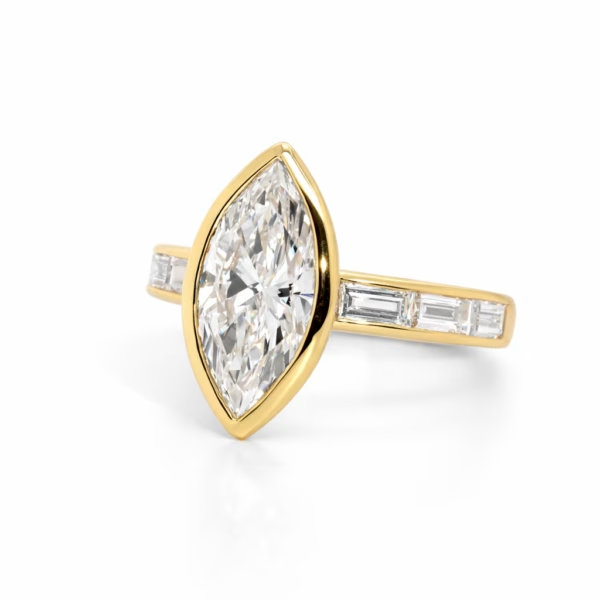
Choosing a two-carat ring that wears well
Two carats earned its place as the default for a good reason. It is the size where presence and practicality meet, and lab grown has made it reachable for couples who would once have settled for less. Pick the shape for how it sits on the hand, decide between lab grown and natural with the resale question answered honestly, insist on certification, and keep the setting proportionate to the stone. If you want to work through those choices properly, that is what our custom engagement ring process is for, and the best place to settle it is with real stones in front of you.
 Bezel-Set Princess-Cut Engagement Ring